

Why the error code is not a parts list
The single most useful thing about a tankless water heater is that it tells you what is wrong. The single most common way the repair goes wrong is treating the code as a parts list. An ignition fault code, for instance, is thrown by a failed igniter, a dirty flame rod, an undersized gas line, a blocked vent and a partially closed gas valve alike. Tell us the code and the brand when you call and we can usually narrow it before we dispatch.
Read the code, then check the supply
Every tankless unit displays an alphanumeric fault code on the unit or in the manufacturer's app. Codes differ by brand and model year, and third-party tables on the internet contradict each other, so we read yours against the correct handbook rather than a universal chart.
Broadly, the families are:
- Ignition and flame failure. The most common family and the one most often misdiagnosed. Check gas supply pressure under load before replacing anything.
- Air supply and exhaust. Blocked or badly terminated venting, or a blocked intake. Weather-dependent and intermittent faults usually live here.
- Overheat and exchanger. Often scale-related, sometimes a genuine exchanger fault.
- Flow and sensor. Flow sensor fouled or failed, thermistors drifting.
- Electrical and board. The rarest, and the last thing we condemn rather than the first.
The ignition fault that is really a gas line
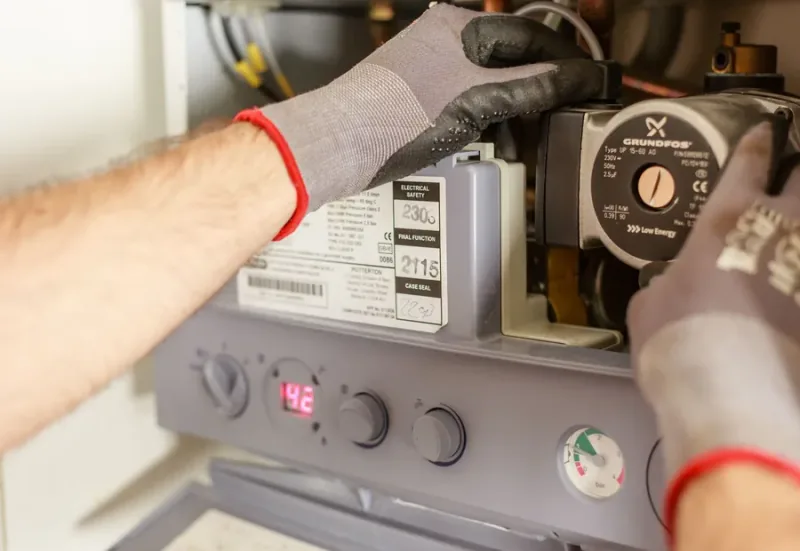
This is the fault we are called out to most, and it is worth understanding because it changes what the fix is.
- The demand quadrupled. A tankless at full fire draws 150,000 to 199,000 BTU against about 40,000 for the tank it replaced.
- An un-upsized line starves it. The unit ignites fine at low fire, then starves as it ramps, throwing a flame failure or a combustion code.
- Which is why it is worse in winter. The temperature rise is greatest and the burner works hardest, so the fault reads as intermittent.
- No part fixes that. We measure gas pressure at the unit, static and under full load, which is the reading that settles it. If the line is undersized the installation was incomplete, and we will say so even when we did not do it.
Cold water sandwich, and what it is not
A burst of hot, then cold, then hot again a few seconds later is the classic tankless complaint, and it is usually not a fault at all. It is the gap between the hot water already in the pipe, the cold slug behind it, and the unit firing and coming up to temperature.
- What genuinely reduces it. A correctly sized unit so it is not cycling, a small buffer tank on units that support one, and a recirculation strategy that suits the unit.
- What does not. Replacing the water heater, which is occasionally what gets sold.
- The related complaint. A unit that will not fire at very low flow, typically a bathroom tap barely open. Every tankless has a minimum activation flow rate, so a trickle that never goes hot is the specification rather than a defect.
When the fault is scale, in a soft-water city
Overheat codes and a drop in flow both point at scale in the heat exchanger. In Charlotte that happens more slowly than the manufacturer's default schedule assumes, because the water is soft at 32 ppm, but it still happens over years.
- Service valves decide the size of the job. With isolation valves fitted, descaling is a straightforward hour. Without them it is a much bigger job, and worth fixing permanently at the same visit. See tankless maintenance.
- Recirculation accelerates it. Timer-driven recirculation on a unit not designed for it cycles the exchanger constantly to reheat water nobody is using, which is a genuine wear mechanism.
- It is a new-build belt pattern. Common through Waxhaw, Weddington and Marvin, where tankless and recirculation were sold together.
- Demand control usually resolves it. Moving off a timer fixes the wear without replacing hardware.
When we will tell you not to repair it
A cracked or corroded primary heat exchanger is not economically repairable in a residential unit. It is also the part most likely to still be under warranty, because exchanger warranties commonly run twelve to fifteen years while parts warranties run five.
We identify it, document it, run the serial and help you file the claim. What we will not do is bill you diagnostic-by-diagnostic toward a conclusion we can already see, which is the most expensive way this particular job goes wrong. If it is out of warranty, our replacement page covers the options honestly, including converting back to a tank.
What the job covers in Charlotte
System focus
Gas and electric tankless units: ignition and flame sensing, gas supply and venting faults, flow sensors, mixing and temperature stability, control boards and heat exchangers.
Target outcome
The fault traced to a specific cause, including the supply-side causes that get misdiagnosed as component failures.
Decision point
Ignition faults on a unit that was recently installed are a supply problem until proven otherwise. A cracked heat exchanger is a warranty path rather than a repair line item.