



One of the two causes is often free to fix
Tankless units last fifteen to twenty years, so a replacement conversation usually means either a heat exchanger failure or an installation that was wrong from the start. Both are worth establishing before you buy anything, because one of them is often free and the other is not fixed by a new appliance.
Run the serial number first
Most tankless manufacturers warrant the heat exchanger for twelve to fifteen years on a residential installation and the remaining parts for around five. The exchanger is also the most common terminal failure, so the fault most likely to end a unit is the one most likely to still be covered.
- We run the serial off the data plate. Check the registration and coverage, and file the claim if one exists. Ten minutes of admin that occasionally replaces the entire cost of the unit.
- Warranty covers the part, not the labor. There is still a bill to fit it, and we would rather you knew that before we start.
- Some manufacturers require documented annual servicing. Without it the exchanger warranty may already be void, which is worth checking before you assume you are covered.
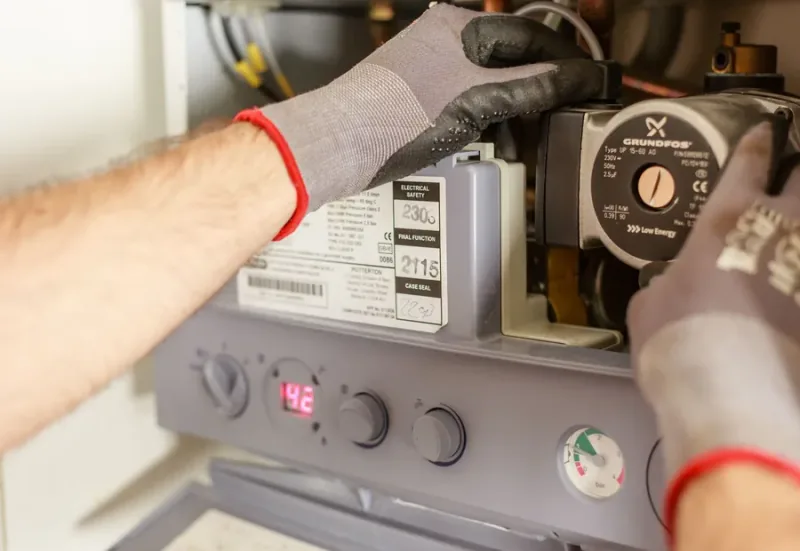
Is the unit actually finished?
Three failures genuinely end a residential tankless unit:
- Cracked or corroded primary heat exchanger. Not economically repairable. Warranty path if it exists.
- Repeated failures across unrelated components on an out-of-warranty unit. At some point the arithmetic changes.
- Obsolete parts. Genuinely rare inside twenty years, but it happens on discontinued models.
What does not mean the unit is finished, whatever you have been told: ignition faults on an under-specified gas line, overheat codes from scale, intermittent faults from a blocked vent terminal, or a cold water sandwich. Those are supply, service and specification problems and a new unit inherits all of them. Our repair page covers each one.
Like-for-like, or upgrade
- If the original was correctly specified, a like-for-like swap is the straightforward case. The gas line, venting and condensate route already suit, so it is largely a day's work and considerably cheaper than the original install.
- If it was under-specified, like-for-like reproduces the fault. The common Charlotte version is a unit on a gas line that was never upsized, which starves at full fire and throws intermittent flame failures, worse in winter.
- So we measure gas pressure under load first. Before quoting a replacement, so you are not paying twice to learn the same thing.
- Non-condensing to condensing changes the venting. Stainless to PVC, plus a condensate drain and neutraliser. Sometimes a saving on the vent run, sometimes an extra, depending on the route.
Going back to a tank
We will say this plainly because most tankless specialists will not: for some Charlotte households, going back to a conventional tank is the better decision.
- When it makes sense. The tankless was oversold in the first place, the gas line cannot be upsized without opening up the house, the household has shrunk, or you are selling and want the simplest reliable answer.
- The economics. A tank is cheaper to buy, cheaper to install, and considerably cheaper to replace next time.
- The work is genuine. Capping or reusing the gas line, removing the tankless venting and making good the penetration, and reinstating a tank with expansion control and a discharge pipe. It is a permit job.
- But it is the answer we will give. If it is the right one for you. See water heater installation.
What the job covers in Charlotte
System focus
Replacement of failed or end-of-life tankless units, like-for-like swaps, upgrades, and conversions back to a conventional tank.
Target outcome
A warranty claim where one exists, and a correctly specified replacement where it does not.
Decision point
Run the serial number before anything else. Exchanger warranties often outlast the assumption that the unit is finished.