



Replacing a tankless in Gastonia
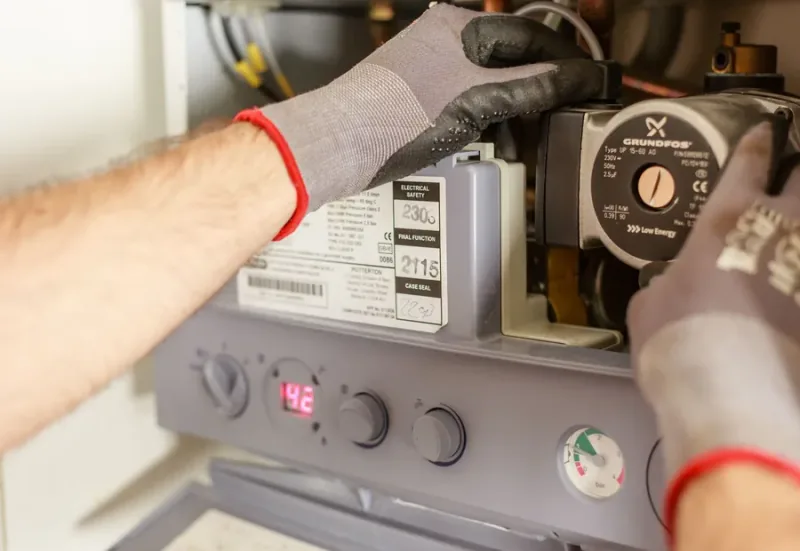
A tankless that has failed is not automatically a tankless that needs replacing. Heat exchangers commonly carry twelve to fifteen year cover while the rest of the unit carries around five, and the exchanger is the most common terminal failure. We run the serial and check the warranty before quoting you for a new unit, because the part is frequently covered even when the labour is not.
Where a replacement is genuinely warranted, the second unit is usually a much simpler job than the first was: the gas line, the venting and the condensate route already exist and were sized once. In Gastonia the permit goes through Gaston County, which handles all trade permitting and inspections, and a like-for-like swap in the same location is a considerably lighter permit question than the original conversion was.
Gastonia has genuinely older housing than Charlotte, and that changes the work. 52.4% of the stock predates 1980 against a Mecklenburg median around 1997, and Gaston County's own comprehensive plan identifies the county as holding the region's largest share of aged housing. In practice that means more third and fourth cycle replacements, more tanks that have never had an anode rod checked, and more properties where the drain valve will not survive its first flush. It also means a more price-sensitive market, and we price and explain accordingly.
What Gastonia itself changes
Where the heaters sit
Crawlspace and basement-adjacent utility spaces are far more common here than in Charlotte proper, because the housing predates the slab-on-grade era. Garage installs appear in the newer south and west subdivisions. Crawlspace access is priced separately and quoted before the visit.
The pipe era
A genuine galvanised layer in the pre-1960 stock, which corrodes inward and restricts the whole house rather than just the hot side. Copper through the 1960s to 1990s, and polybutylene in the 1980s subdivisions. If your complaint is that pressure has been getting steadily worse for years across both hot and cold, galvanised supply is the likely answer and that is a repipe conversation rather than a water heater one.