



Misdiagnosed in your favour, and against it
Water on the floor is the one water heater symptom that can genuinely be an emergency, and also the one most often misdiagnosed in your favour or against it. The whole question is where the water is coming from, and that is usually answerable in about two minutes once you know where to look.
First: stop the damage
If water is running rather than dripping, three things before anything else.
- Shut the cold inlet. The valve on the cold pipe entering the top of the heater. Fully clockwise, or the lever 90 degrees across the pipe. If it will not move, shut the main.
- Kill the energy. Electric: the breaker. Gas: the control knob on the front to OFF, not just the thermostat turned down.
- Do not drain it yet. On an attic unit, opening the drain without a hose routed properly makes it worse. Contain what you can and call.
If it is in the attic, check the ceiling below for staining or bulging first. The attic install is standard in Charlotte's newer south and southwest subdivisions, and a failure there is a ceiling event rather than a wet floor.
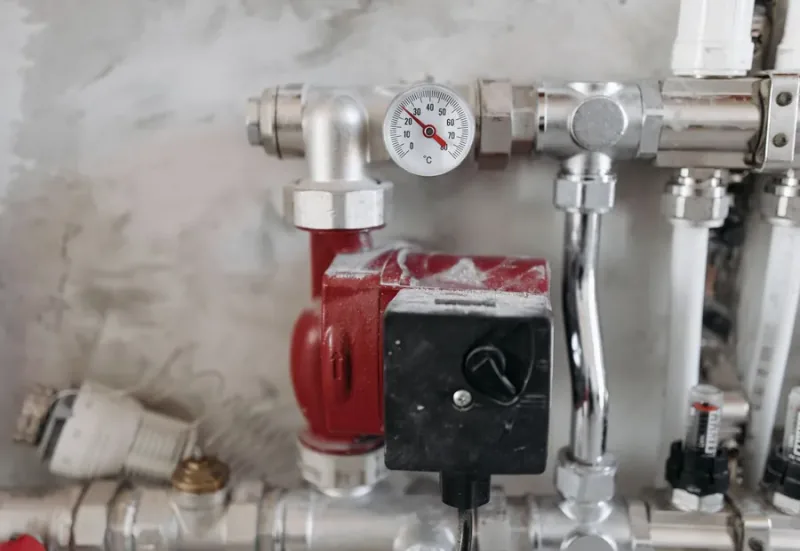
Triage: where is it actually leaking from?
| Where the water is | What it usually means | Repair or replace |
|---|---|---|
| Running down the outside of the tank from no visible fitting | Tank body perforated | Replace |
| At the top, around the inlet or outlet pipe | Loose or corroded connection, failed nipple | Repair, $150 - $300 |
| From the pipe running down to the floor | T&P relief valve discharging | Repair, usually a pressure problem |
| At the drain valve near the bottom | Valve not reseating, common on older tanks | Repair, $125 - $225 |
| From a round access panel on the side | Element gasket failed | Repair, $150 - $275 |
| From the small tank above or beside the heater | Expansion tank diaphragm ruptured | Repair, $300 - $600 |
| Clear water, appearing slowly, near a small pump or thin tube | Condensate line or pump, hybrid units | Repair, $150 - $475 |
| Water in the pan but the tank looks dry | Often condensation, or a leak from above | Diagnose before replacing anything |
The test that settles the big one: dry the tank completely, then watch. Water reappearing on the shell itself, away from every fitting, means the steel has perforated. At a joint, it is a joint.
A dripping relief valve in Charlotte is usually a pressure problem
The most misdiagnosed leak in the city. The complaint is always "they replaced the valve and it is still leaking", and the reason is that the valve was doing its job.
A T&P valve opens at 150 psi or 210°F. Charlotte Water documents system pressures that swing with the terrain: 40 psi or lower at higher elevations, and well above 100 psi at low points near a creek or the bottom of a neighbourhood. At 110 or 120 psi static, one heating cycle in a closed system closes the gap to 150.
- Test it yourself for $12. A hose-bib gauge, read with no water running. Anything above 80 psi is past the threshold at which county code requires a pressure reducing valve.
- Leave it on overnight. If the reading climbs above static while nobody is using water, you have a closed system with thermal expansion, and that is what is lifting your valve.
- The wrong valve is a common error. A 30 psi boiler valve fitted where a 150 psi water heater valve belongs will discharge constantly.
- Never cap the discharge line. It is prohibited, and it converts a nuisance into a rupture risk. Decline anyone who offers it.
The expansion tank nobody charged correctly
If the valve keeps weeping and the pressure is high, the expansion tank is the next suspect, and in Charlotte it is very often the culprit. Tanks ship pre-charged at 20 to 40 psi while Charlotte homes routinely run 80 to 120, so one fitted without adjusting it is waterlogged from day one and has never worked.
- Three tests, one minute. Rap it top and bottom, listening for hollow above and dull below; lift it, because a working tank is surprisingly light; press the Schrader pin, where air is correct and water means a ruptured diaphragm.
- 80 psi is a hard ceiling. The air charge cannot exceed it, so a home running higher cannot be served by a tank alone. The pressure has to come down first via the PRV, which is the honest basis for doing both together rather than an upsell.
- 2007 is the date that matters. North Carolina did not require pressure reducing valves before it, so homes from 2007 onward are closed systems with builder-fitted tanks now five to nineteen years old against a five to ten year life.
- A pre-2007 home may not need one. It may genuinely be an open system, and we will tell you so.
When the tank itself has gone
A perforated tank cannot be patched, welded or sealed, and anyone offering to is selling you a delay. The glass lining has failed, the steel behind it has corroded through, and the hole only gets bigger.
In Charlotte this is the dominant end-of-life failure rather than a gradual decline, because the water is soft, low in dissolved solids and lightly buffered, which is corrosive rather than scaling. That is why a maintained anode rod genuinely extends tank life here, and why we push maintenance harder than most. Our replacement page covers sizing and the local price spread.
What the job covers in Charlotte
System focus
Leaks at the tank body, fittings and unions, T&P relief valves and discharge pipes, drain valves, element gaskets, expansion tanks and condensate lines.
Target outcome
The leak sourced to a specific component, stopped, and an honest statement of whether the tank itself is still sound.
Decision point
Leaking from the tank body means replace. Everything else on this page is a repair, and most of them cost between $150 and $350.