



Why the tank is the cheapest decision you make
Charlotte water heater installation looks like a commodity job and is not. The tank itself is the cheapest decision in the process. What determines whether you are happy in three years is whether it was sized to the household you actually have, whether the expansion tank was charged to your home pressure rather than the factory default, and whether the connections were done in a way that will still be sound when the next plumber opens the panel.
Sizing, the decision that matters most
The most common complaint after a new installation is not that it failed. It is that the hot water still runs out, and that is a sizing problem: the replacement was matched to the old tank instead of to the household.
- The 2000s build stock is undersized now. Steele Creek, Ballantyne, Stallings and Indian Trail are full of 40 and 50 gallon tanks sized for the household the builder imagined. Those homes now have teenagers and a second bathroom in daily use.
- We size on first-hour rating, not raw capacity. How much hot water the unit actually delivers in the busiest hour of your day, given its recovery rate.
- A 50 gallon gas and a 50 gallon electric are not the same appliance. Gas recovers far faster, so the number on the label settles nothing on its own.
- So we ask three questions. How many people, how many bathrooms, and when everyone showers, then tell you what that means.
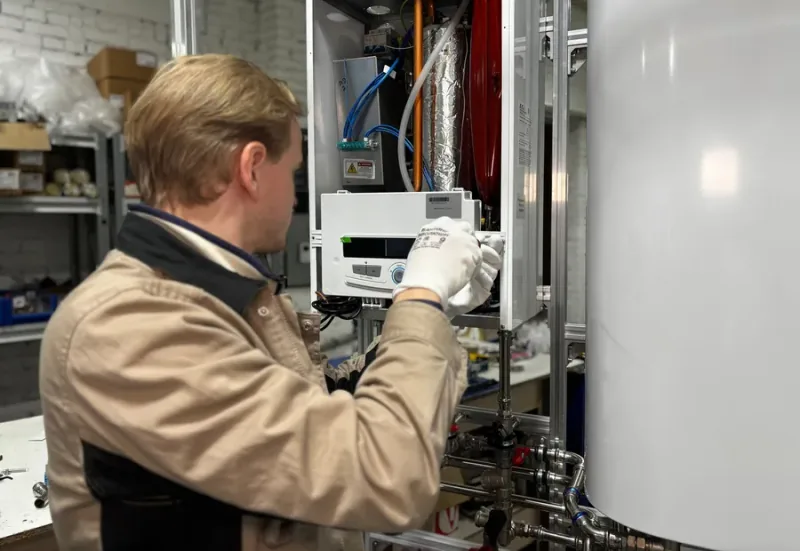
Gas or electric in a Charlotte home
About 75% of North Carolina homes heat water with electricity, so for most Charlotte addresses the honest answer is to stay with what you have. Changing fuel is a permit job, usually needs new venting or a new circuit, and rarely pays for itself on running cost alone.
Where it is worth a conversation: if you already have gas at the property and a household big enough that recovery rate is the constraint, gas genuinely solves a problem electric cannot. Piedmont Natural Gas is the only residential gas provider in the Charlotte area and they install water heaters too, frequently cheaper than a private contractor. We would rather tell you that than have you find out afterwards. What they do not do is diagnostic work, after-hours calls, or the pockets of the metro their contractor coverage does not reach.
What a compliant Charlotte installation actually includes
These are the items that separate an installation that passes inspection from one that comes back:
- Expansion control charged to your pressure. An expansion tank ships pre-charged at 20 to 40 psi. Charlotte homes routinely run 80 to 120. Fitted without adjustment it is compressed flat the moment the water is turned on and never works. We gauge your static pressure and set the pre-charge to match.
- A discharge pipe that will pass. Full valve size, no valves or tees in the line, no threads on the terminal end, terminating within six inches of the floor, gravity flow with no traps, air gap maintained, serving one device only.
- A pan and a drain line where the install is above living space. Non-negotiable in Charlotte's attic installs, where a failure is a ceiling event.
- Dielectric protection at the connections so dissimilar metals do not set up a corrosion cell at the nipples.
- Correct venting and combustion air on gas units, checked rather than assumed.
- Seismic strapping is not a Charlotte requirement, whatever national content tells you.
Where it goes, and what that costs
Only about 3% of Mecklenburg County homes have a basement, so the four realistic locations here are the garage, a utility closet, a crawlspace, or the attic. Access drives a real part of the price, and we quote it before the visit rather than after we are under the house.
- Garage and closet. The straightforward case, and the one the published range assumes.
- Attic, in the newer south and southwest subdivisions. Needs the pan, the drain line and a safe working platform.
- Crawlspace, through the pre-1980 core. Priced separately, locally $150 to $800 depending on clearance and condition.
- Moving it somewhere else. A permit job and a different quote. Sometimes worth it, particularly getting a tank out of an attic, and we will tell you honestly what it involves.
Permits, plainly
NC GS 160D-1110 exempts a like-for-like water heater connection in a one or two family dwelling when a licensed plumber does it: no change of fuel, location, capacity, venting or pipe routing. That covers most straight replacements.
You do need a permit if you are changing fuel, relocating the unit, converting to tankless, or fitting a hybrid, which needs both plumbing and electrical permits. Mecklenburg contractors pull trade permits through TIP, which issues online instantly and around the clock, so a permit is not a reason for the job to wait. Code Enforcement is on 980-314-2633 if you want any of this confirmed directly.
What the day looks like
- We confirm sizing and location with you, and give you the written price before anything is disconnected.
- Water and fuel isolated, old unit drained and removed from the property. Haul-away is included, and Mecklenburg also collects old water heaters free through bulky item collection if you would rather keep it.
- New unit set on new flexible connectors, expansion control fitted and charged to your measured pressure, discharge pipe run correctly, pan and drain where required. The connectors are part of the job, not an extra line on the invoice.
- Fill, purge the air at a hot tap, then energise. On electric units this order matters: energising an element before the tank has fully refilled destroys it in under a minute.
- Commission, check temperature at a fixture, walk you through the shutoffs and the warranty, and clean up.
Most straightforward replacements are a half-day job.
What the job covers in Charlotte
System focus
Gas and electric tank water heater installation in Charlotte homes, including sizing, venting, expansion control, pan and drain, and permit handling.
Target outcome
A correctly sized unit installed to code, commissioned, and documented, with the old one removed and the area left clean.
Decision point
Like-for-like in the same location with the same fuel is exempt from permit under NC GS 160D-1110 when a licensed plumber does it. Change the fuel, location, capacity, venting or routing and it becomes a permit job.