



Worth doing, and the most oversold service here
Tankless maintenance is genuinely worth doing, and it is also the service most often oversold in this market. The honest position for Charlotte is that the water is soft, low in dissolved solids and lightly buffered, so exchangers here foul more slowly than the default schedule assumes. What still matters on time are the filter screen, the venting and, on condensing units, the condensate neutraliser.
How often, honestly, in Charlotte
Manufacturer schedules typically say annually. That figure is set for a market average considerably harder than 32 ppm.
Our local guidance:
- Standard household, city water, no recirculation: descale every two to three years, with an annual check of the filter screen and venting.
- With a recirculation loop: annually. The loop keeps water moving through the exchanger continuously and that changes the arithmetic.
- Private well in Union, Cabarrus, Iredell or Lincoln County: annually or more, and test the water rather than guessing. Well chemistry here is nothing like Charlotte Water's.
- Any unit throwing overheat codes or showing reduced flow: now, regardless of schedule.
Worth checking your warranty terms, because some manufacturers require documented annual servicing to keep the exchanger warranty intact. If yours does, that requirement outranks our advice and we will service it on the manufacturer's schedule and give you the documentation.
What a descale actually involves
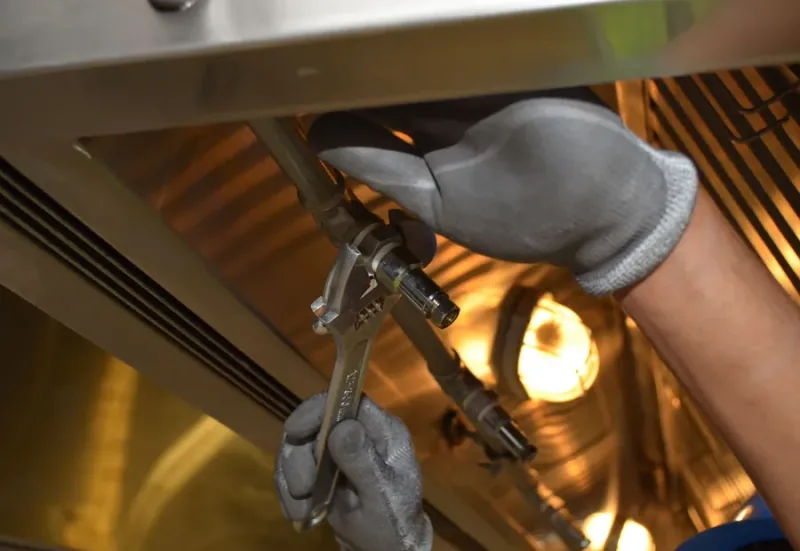
With isolation service valves fitted, it is a straightforward job: isolate the unit, connect a circulating pump and a bucket at the service ports, run a food-grade descaling solution through the heat exchanger for the manufacturer's specified period, flush with clean water, and return the unit to service.
Without service valves, the unit has to be partly disconnected to do the same thing, which turns an hour into most of a morning. If yours does not have them, we will quote fitting a kit alongside, and it usually pays for itself by the second service.
The parts of the service that are not descaling
- Inlet filter screen. A small mesh screen on the cold inlet that catches debris. It clogs, and when it does the symptom is reduced flow that looks exactly like scale. Cleaning it is a five minute job and it is the first thing we check.
- Venting and intake. Blocked or partly obstructed terminals cause intermittent, weather-dependent faults. Worth a look every year.
- Condensate neutraliser. On condensing units the media is consumed and needs replacing. Neglected, acidic condensate attacks the drain line.
- Flow rate verification. We measure actual delivered flow at temperature so you have a number to compare against next time, rather than an impression.
- Gas pressure under load. Particularly valuable on units that have never been checked since installation, because an undersized gas line is common here and shows up as intermittent faults.
If you have a recirculation loop, read this
Tankless and recirculation were sold together heavily across the Union County new-build belt, and the pairing is a real local wear pattern.
- A timer-driven loop never rests. It cycles the heat exchanger constantly to reheat water nobody is drawing.
- Some units are built for it, most are not. Without a built-in buffer tank and pump, it shortens exchanger life and pushes the descaling interval down to annual.
- Demand control is the cheap fix. A button or sensor that runs the pump only when someone is about to use hot water usually resolves it without replacing anything, with a real effect on how long the unit lasts.
What the job covers in Charlotte
System focus
Heat exchanger descaling, inlet filter screen, isolation valve fitting, flow rate verification, combustion and venting checks, condensate neutraliser service.
Target outcome
A unit holding its rated flow and temperature, on a service interval that matches the actual water it is running.
Decision point
Without isolation service valves, every descale is a much bigger job. Fitting them once is usually cheaper than the second descale without them.