



Replacing a tankless in Waxhaw
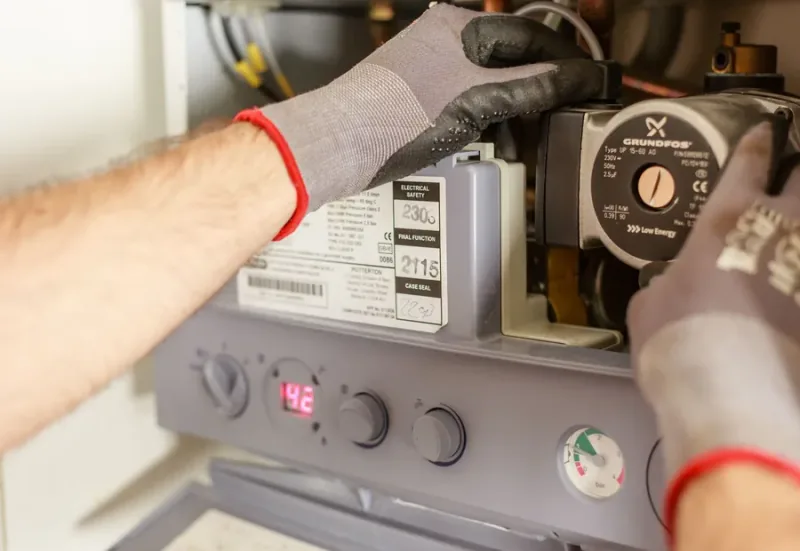
A tankless that has failed is not automatically a tankless that needs replacing. Heat exchangers commonly carry twelve to fifteen year cover while the rest of the unit carries around five, and the exchanger is the most common terminal failure. We run the serial and check the warranty before quoting you for a new unit, because the part is frequently covered even when the labour is not.
Where a replacement is genuinely warranted, the second unit is usually a much simpler job than the first was: the gas line, the venting and the condensate route already exist and were sized once. In Waxhaw the permit goes through the Town of Waxhaw and Union County, and a like-for-like swap in the same location is a considerably lighter permit question than the original conversion was.
Waxhaw is two things at once. 2,282 homes went up between 2000 and 2009 and are now firmly on their second water heater, while only 8.3% of the town was built in 2020 or later. Then there is the 93-building National Register district downtown, built between 1888 and 1940 with the railway running through the middle of it, where the plumbing is nothing like the subdivisions.
What Waxhaw itself changes
Where the heaters sit
Garage, closet and attic installs across the newer subdivisions. Tankless is unusually common here, because it was sold heavily across the Union County new-build belt, frequently alongside a recirculation loop. That pairing is worth checking, because a timer-driven loop on a unit not designed for one wears the heat exchanger.
The pipe era
Copper and PEX in the 2000s stock, polybutylene in the 1980s and 1990s portion, and genuinely old supply in the historic district. Slab-on-grade construction dominates the newer areas, which is why a dedicated recirculation return is rarely practical and a crossover valve is the usual retrofit.